Home / Dog calculators
Puppy teething chart
Puppies grow 28 baby teeth in their first weeks, start losing them at around 3–4 months, and have all 42 adult teeth by about 6–7 months. Enter your puppy's birth date to see which stage it is in.
Your puppy's teething stage will show here.
Ages are typical ranges; small and large breeds can be a little earlier or later. Last reviewed October 9, 2026.
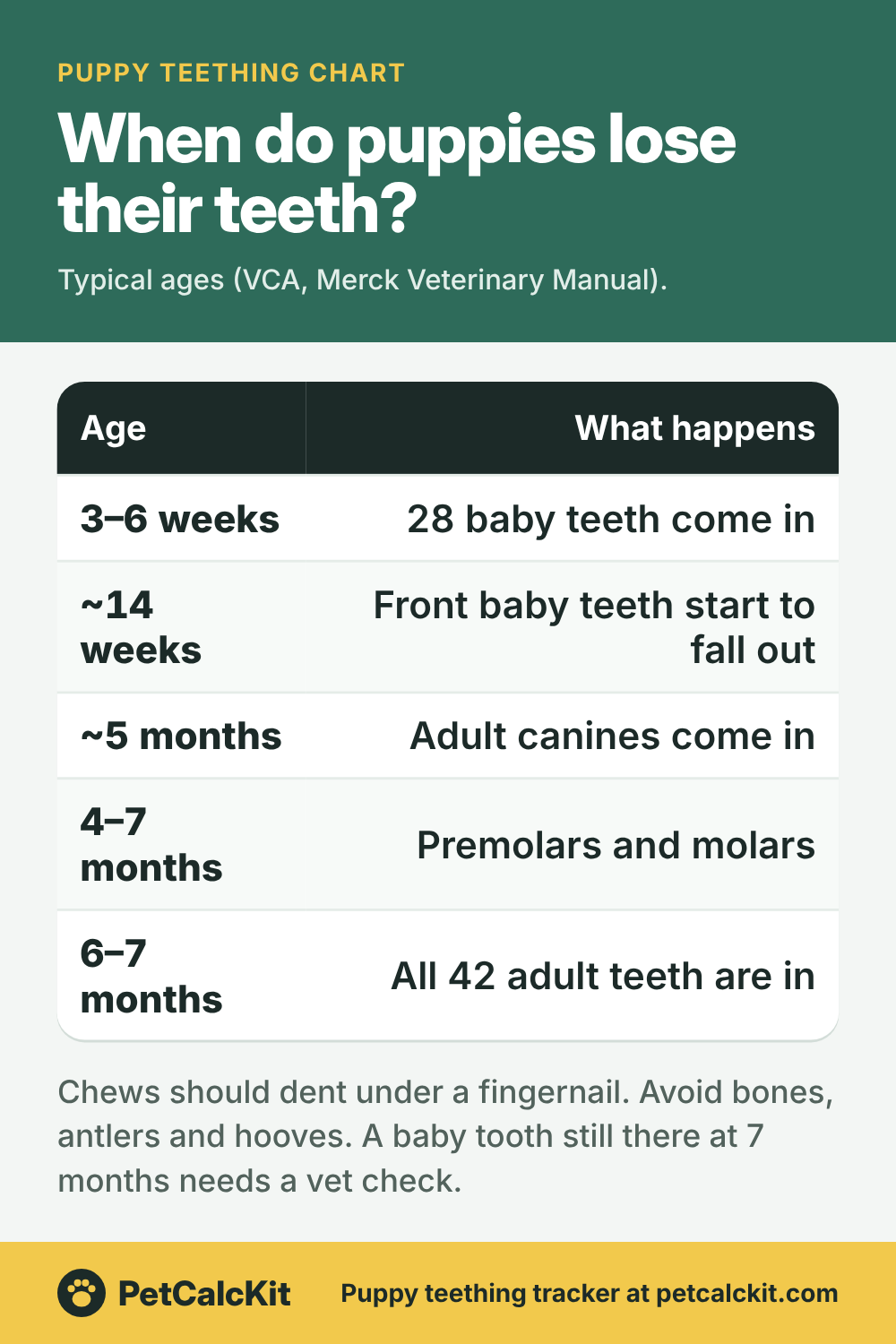
Puppy teething timeline
| Age | What's happening |
|---|---|
| Birth to 3 weeks | No teeth yet. Puppies only nurse. |
| 3–8 weeks | Baby (deciduous) teeth come in. VCA says they start at about 3 weeks and are usually all in by about 6 weeks; Merck gives 3–5 weeks for the first ones. |
| 8–14 weeks | A full set of 28 sharp baby teeth. Puppies explore everything with their mouths, so give them suitable chew toys. |
| 14 weeks–5 months | Baby teeth start to fall out as adult teeth push through, usually beginning with the front teeth (incisors). Merck says this normally starts at around 14 weeks with the upper central incisors. |
| 5–7 months | Adult canines come in at around 5 months, and premolars and molars between 4 and 7 months (VCA). This is when chewing is at its peak. |
| 7 months and older | All 42 adult teeth are in: by 6–7 months according to VCA, by 7 months according to Merck. Teething is over. A baby tooth that is still there now needs a vet check. |
Puppy teeth chart: baby teeth vs adult teeth
| Tooth type | Baby teeth | Adult teeth | Adult teeth come in |
|---|---|---|---|
| Incisors (front teeth) | 12 | 12 | From about 3–4 months |
| Canines (fangs) | 4 | 4 | Around 5 months |
| Premolars | 12 | 16 | 4–7 months |
| Molars | 0 | 10 | 4–7 months |
| Total | 28 | 42 | All in by about 6–7 months |
Tooth counts from the Merck Veterinary Manual and the canine dental formula (WikiVet); ages from VCA Animal Hospitals and Merck. Puppies have no baby molars, so the molars come in only once.
Signs your puppy is teething
- Chewing everything: teething puppies want to chew, so give them something allowed before they find your shoes.
- A little blood: VCA says a small amount of bleeding is okay. You may see spots on toys.
- Missing or tiny teeth: you may find a baby tooth on the floor, but most are swallowed while the puppy eats. VCA says this does no harm.
Call your vet if your puppy stops eating, the gums are very swollen or bleed a lot, or a tooth looks broken or discolored.
Safe chews for a teething puppy
- Use the fingernail test: VCA and Cornell both say you should be able to dent a chew with your fingernail. If you can't, it is hard enough to break a tooth.
- Avoid very hard items: VCA warns against nylon, bones and antlers, and Cornell adds hooves. Cornell also says not to let dogs crunch ice cubes, although licking and playing with them is fine.
- Try something cold: VCA suggests freezing toys and treats to soothe sore gums.
- Look for the VOHC seal: the Veterinary Oral Health Council lists dental chews and products it has accepted.
Retained baby teeth
A baby tooth that hasn't fallen out when the adult tooth comes in is called a retained (persistent) deciduous tooth. VCA says the upper canines are most often affected, followed by the lower canines and the incisors, and that it is more common in small breeds and flat-faced breeds such as bulldogs, pugs, Boston terriers and boxers.
Two teeth in one spot push the adult tooth out of place, which can cause an abnormal bite, and the crowding traps food and leads to gum disease. VCA says retained baby teeth should be removed promptly rather than waiting until the puppy is spayed or neutered. Merck recommends extracting a retained tooth once the adult tooth has begun to come in.
Start brushing early
Get your puppy used to having its mouth handled while it is young. VCA says veterinary dentists recommend brushing once a day, with a toothpaste made for pets: never use human toothpaste, which isn't designed to be swallowed.
Questions people ask
When do puppies start teething?
Baby teeth start to come in at about 3 weeks of age, and most puppies have all 28 by about 6 weeks. The more noticeable teething, when baby teeth fall out and adult teeth come in, starts at around 3–4 months.
When do puppies lose their teeth?
From about 14 weeks (3–4 months), starting with the front incisors. The canines are replaced at around 5 months and the back teeth between 4 and 7 months.
When do puppies stop teething?
At about 6–7 months, when all 42 adult teeth have come in. Many young dogs still like to chew after that, so keep safe chews around.
Is it normal for a teething puppy's gums to bleed?
A small amount of bleeding is okay, according to VCA. Heavy bleeding, very swollen gums or a puppy that won't eat needs a vet visit.
Do puppies swallow their baby teeth?
Usually, yes. Most baby teeth are swallowed while the puppy eats, and VCA says this causes no harm.
What can I give my teething puppy?
Chew toys that you can dent with a fingernail, frozen toys or treats, and products with the VOHC seal. Avoid bones, antlers, hooves and hard nylon toys, which can break teeth.
Sources
- Merck Veterinary Manual: Dental development of dogs
- Merck Veterinary Manual: Dental disorders of dogs
- Merck Veterinary Manual: Developmental abnormalities of the mouth and dentition
- VCA Animal Hospitals: Puppy teething toys
- VCA Animal Hospitals: Retained baby teeth in dogs
- VCA Animal Hospitals: How to brush puppy teeth
- Cornell Riney Canine Health Center: Risks of a fractured tooth
- WikiVet: Dental formula of the dog
- Veterinary Oral Health Council (VOHC)