Home / Dog calculators
Puppy development stages
Puppies go from blind and deaf newborns to adolescents in about six months. Enter your puppy's birth date to see which stage it is in, then read what happens at each age.
Your puppy's stage and what to focus on will show here.
Ages are typical ranges; breeds and individual puppies vary. Last reviewed October 8, 2026.
Puppy development timeline
| Age | What's happening |
|---|---|
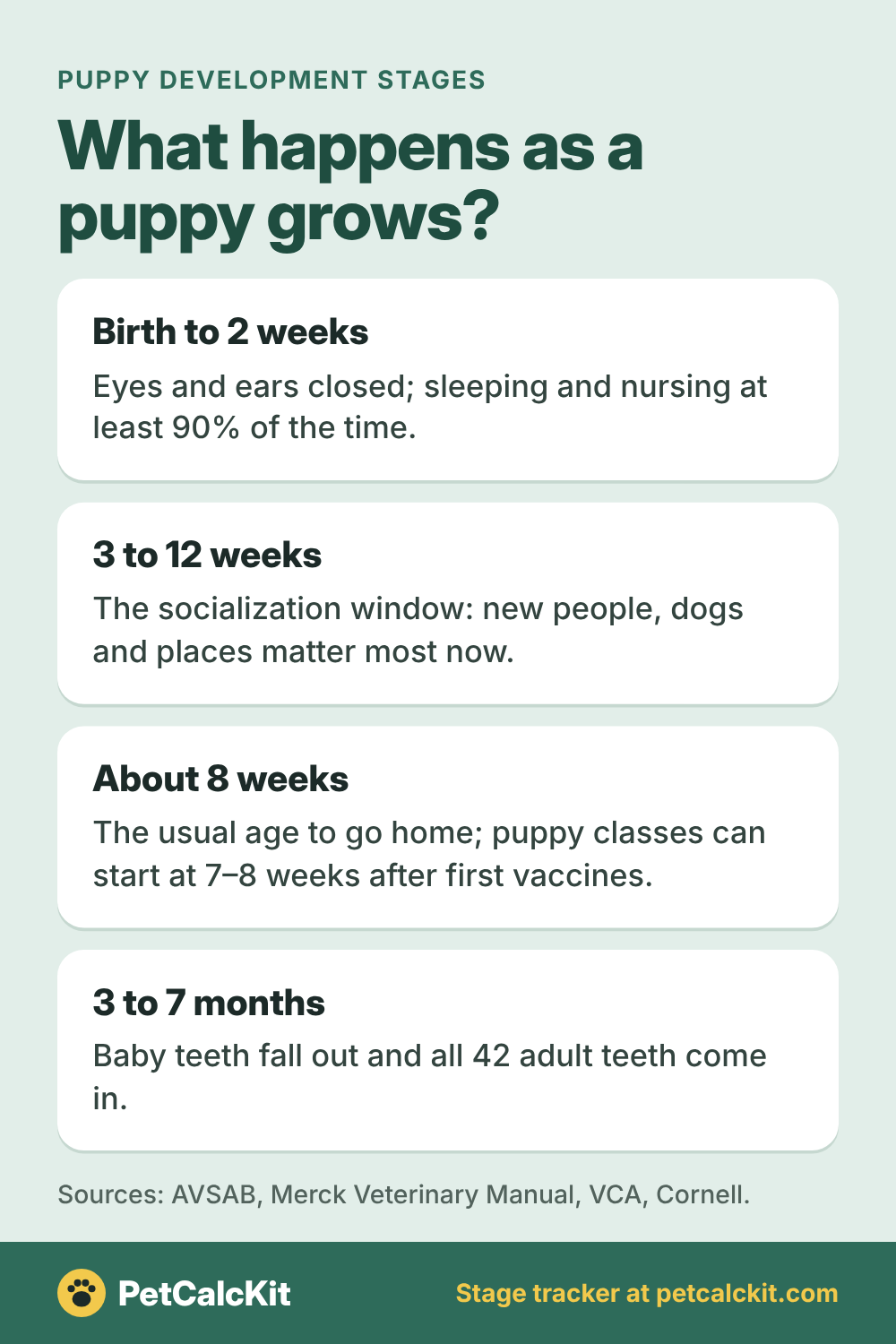
| Neonatal: birth to 2 weeks | Eyes and ears are closed. Puppies spend nearly all their time sleeping and nursing, can't keep themselves warm for the first week or two, and need their mother to lick them to make them pee and poop. |
| Transitional: about 2–3 weeks | Eyes and ears open, and puppies start trying to stand. They begin to pee and poop without their mother's help. |
| Early socialization: 3–5 weeks | Baby teeth start coming in at about 3–5 weeks, and weaning begins at 3–4 weeks. By 4 weeks puppies walk, run and play with their littermates, and learn from their mother to move away from the sleeping area to eliminate. |
| Socialization: 5–8 weeks | All 28 baby teeth are in by about 6 weeks. Puppies move onto solid food, and the first vaccines are due at 6–8 weeks. Gentle handling and new experiences now shape how confident the puppy will be. |
| Socialization: 8–12 weeks | The usual age to go to a new home is about 8 weeks. Puppy classes can start at 7–8 weeks, at least 7 days after the first vaccines and after a first deworming. Meet new people, dogs, sounds and places in a positive, safe way: this is the most important window for socialization. |
| 12–16 weeks | The main socialization window closes around 12–14 weeks, so keep up gentle new experiences. Puppy vaccines continue until at least 16 weeks. Most puppies go from four meals a day to three. |
| Juvenile: 4–6 months | Baby teeth fall out and the 42 adult teeth come in, so expect lots of chewing. The puppy vaccine series usually ends at about 16 weeks; under the WSAVA guidelines used outside the US and Canada, a core booster follows at about 26 weeks. |
| Adolescence: 6–12 months | All adult teeth are in by about 7 months. Sexual maturity starts at 6–9 months (later in giant breeds), with a first heat at about 6 months on average in females. Most dogs drop to two meals a day. |
| Young adult: 1–2 years | Small and medium breeds are close to adult size around 1 year, while large and giant breeds keep growing until 18–24 months. Social maturity comes later, at 12–36 months. |
Stages and ages from the Merck Veterinary Manual, VCA Animal Hospitals, Cornell and the American Veterinary Society of Animal Behavior (AVSAB); vaccine timing from the AAHA and WSAVA guidelines. Sources disagree slightly on exact weeks; we use the most common ranges.
The socialization window
The AVSAB calls the first three months of life the primary and most important time for socialization, because during this period a puppy's sociability outweighs its fear. Puppies that meet many people, dogs and situations in a positive way during this window are less likely to develop behavior problems, which are the number one reason dogs are given up to shelters.
You don't have to wait until all vaccines are finished. AVSAB says puppies can start socialization classes as early as 7–8 weeks, as long as they had a first set of vaccines at least 7 days before the first class and a first deworming, and stay up to date. See the puppy vaccine schedule for the dates.
Puppy teething timeline
| Age | Teeth |
|---|---|
| 3–6 weeks | 28 baby (deciduous) teeth come in |
| About 3–4 months | Baby teeth start to fall out as adult teeth push through |
| 6–7 months | All 42 adult teeth are in |
A baby tooth should never share a spot with an adult tooth. If a baby tooth is still there when the adult tooth comes in, most often a canine, ask your vet: these retained teeth usually need to be removed.
Weaning and feeding
Weaning starts at about 3–4 weeks, when teeth appear, and most puppies are fully on solid food by 7–10 weeks. After that, puppies eat four meals a day until about 12 weeks, three until 6 months and two after that. The puppy feeding chart shows how much.
House training by age
Young puppies can't hold it for long. VCA recommends taking them out every 1–2 hours while they're awake and not leaving them in a crate for more than about 3 hours. Many puppies still need a trip outside during the night until about 5 months of age.
Questions people ask
When do puppies open their eyes?
Between about 1 and 2 weeks of age. Their ears open around the same time, during the transitional period at about 2–3 weeks.
When can puppies leave their mother?
Most vets and breeders agree on about 8 weeks as a good minimum. Many US states don't allow puppies to be sold younger than 8 weeks; a few set 7 weeks.
What is the puppy socialization period?
Roughly 3 to 12–14 weeks of age, when puppies accept new people, animals and experiences most easily. What they meet in this window shapes their behavior as adults.
When do puppies stop teething?
By about 6–7 months, when all 42 adult teeth have come in. Expect the most chewing while the adult teeth push through, from about 3–4 months on.
When does a puppy become an adult dog?
Physically, small breeds are close to adult size at about a year and large breeds at 18–24 months. Adolescence starts at 6–9 months, and social maturity comes at 1–3 years.
How long can a puppy hold its bladder?
Not long. Plan on a trip outside every 1–2 hours while your puppy is awake, and don't crate it for more than about 3 hours at a time.
Sources
- AVSAB: Position statement on puppy socialization
- Merck Veterinary Manual: Social behavior of dogs
- Merck Veterinary Manual: Dental development of dogs
- VCA Animal Hospitals: Caring for newborn puppies
- VCA Animal Hospitals: Teeth, teething and chewing in puppies
- VCA Animal Hospitals: Retained baby teeth in dogs
- VCA Animal Hospitals: House training your puppy
- Cornell Riney Canine Health Center: How long should puppies stay with their mother?
- VCA Animal Hospitals: Estrous cycles in dogs
- AAHA: 2022 Canine Vaccination Guidelines
- WSAVA: Vaccination guidelines
- Animal Legal & Historical Center: State laws on the minimum age for selling puppies