Home / Dog calculators
Puppy vaccine schedule
Enter your puppy's date of birth to see when each vaccine is due, from the first shots to the boosters. The dates follow the AAHA guidelines for the US and Canada, or the international WSAVA guidelines elsewhere.
Your puppy's vaccine dates will show here.
A planning guide, not medical advice. Your vet sets the final schedule based on your puppy's health, the vaccines they use and local law. Last reviewed October 7, 2026.
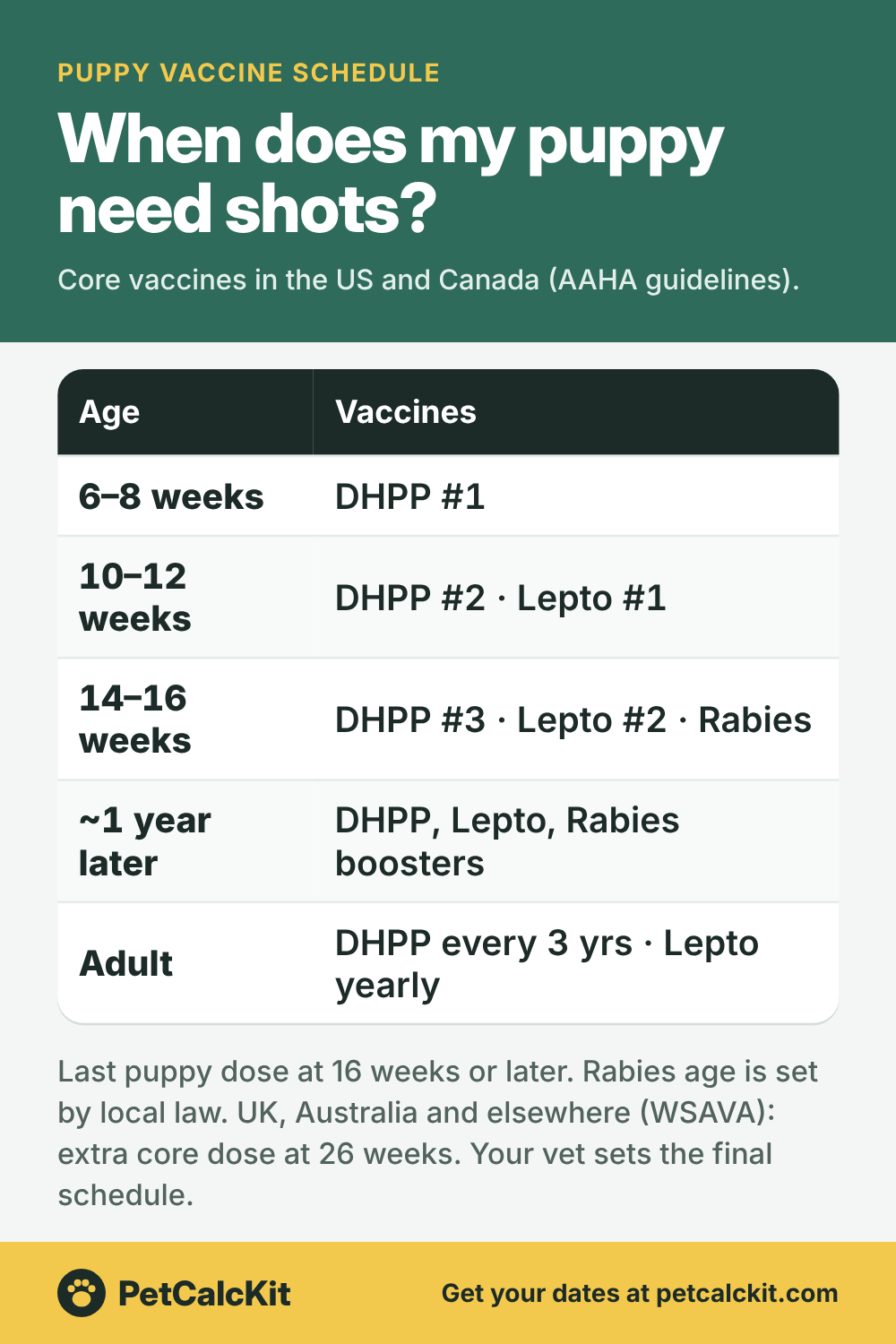
Puppy vaccine schedule chart
Puppies get their first core vaccines at 6–8 weeks, then a dose every 2–4 weeks until they are at least 16 weeks old. The two main veterinary guidelines agree on that, but differ on leptospirosis, rabies and the first booster.
| Age | US and Canada (AAHA) | UK, Australia and elsewhere (WSAVA) |
|---|---|---|
| 6–8 weeks | DHPP, dose 1 | Core vaccine (DHP), dose 1; leptospirosis, dose 1 (usually from 8 weeks) |
| 10–12 weeks | DHPP, dose 2; leptospirosis, dose 1 (from 12 weeks) | Core vaccine, dose 2; leptospirosis, dose 2 |
| 14–16 weeks | DHPP, dose 3 (at 16 weeks or later); leptospirosis, dose 2; rabies (age set by law) | Core vaccine, dose 3 (at 16 weeks or older); rabies only where local law requires it |
| 26 weeks | No dose | Core booster, or a blood test from 20 weeks to check protection |
| About 1 year after the puppy shots | DHPP, leptospirosis and rabies boosters | Leptospirosis booster |
| Adult dog | DHPP every 3 years; leptospirosis every year; rabies every 1 or 3 years | Core vaccines no more often than every 3 years; leptospirosis every year |
DHPP (also written DAPP or DA2PP) covers distemper, adenovirus type 2 (which protects against infectious canine hepatitis), parvovirus and parainfluenza. Many vets give it as a single combined injection.
Why the last puppy shot matters most
A puppy gets antibodies from its mother's milk. They protect it in the first weeks of life, but they can also block a vaccine from working. The AAHA guidelines say these maternal antibodies against distemper are usually gone by 12–14 weeks, while those against parvovirus may last until 13–15 weeks or longer. Because nobody knows exactly when a given puppy's antibodies fade, the series continues until at least 16 weeks of age.
The WSAVA calls the dose at 16 weeks or older the most important one. It also recommends an extra core dose at or shortly after 26 weeks (or a blood test from 20 weeks of age), which replaces the older "first annual booster" at 12–16 months.
Leptospirosis is now a core vaccine in the US
Leptospirosis is a bacterial disease spread in the urine of infected animals, often through puddles and wet ground. In January 2025 the American Animal Hospital Association (AAHA) moved the leptospirosis vaccine from non-core to core, which means it now recommends it for most dogs. Puppies get two doses 2–4 weeks apart starting at 12 weeks, then a booster every year. The WSAVA counts it as core wherever the disease is common, usually starting from 8 weeks depending on the vaccine.
When puppies get the rabies shot
- United States and Canada: rabies vaccines are labeled for puppies 3 months (12 weeks) and older. State, provincial or local law sets the exact age and how often boosters are due. A booster is due 1 year after the first shot, then every 1 or 3 years depending on the vaccine and the law.
- United Kingdom: rabies has been eradicated from UK animals other than bats, so it isn't part of the routine schedule. If you plan to travel abroad, your puppy can be vaccinated from 12 weeks. For the EU or Northern Ireland you must wait at least 21 days after the vaccination before travelling; other countries can require a blood test and a longer wait, so check GOV.UK before booking.
- Australia: Australia is free of rabies, so it isn't part of the routine puppy schedule.
Lifestyle vaccines
Lifestyle (non-core) vaccines are given to dogs whose life puts them at risk, such as dogs that go to boarding kennels, daycare or tick areas. Your vet will suggest them based on where you live and what your dog does.
| Vaccine | Puppy doses | Then |
|---|---|---|
| Kennel cough (Bordetella), nose or mouth | One dose; some products from 3 weeks, others from 7–8 weeks | Every year |
| Kennel cough (Bordetella), injection | Two doses, 2–4 weeks apart | Every year |
| Lyme disease | Two doses, 2–4 weeks apart, from about 8 weeks | Every year, just before tick season |
| Canine influenza (dog flu) | Two doses, 2–4 weeks apart, from 6 weeks | Every year |
The AAHA does not recommend the canine influenza vaccine for all dogs. Ask your vet whether it makes sense for yours.
Keep your puppy's vaccine record and bring it to every visit. Boarding kennels, daycares, groomers and travel rules often ask for proof of vaccination.
Questions people ask
When should a puppy get its first shots?
At 6–8 weeks of age. Both the AAHA and WSAVA guidelines start the core vaccines in that window, then repeat them every 2–4 weeks until the puppy is at least 16 weeks old.
How many rounds of shots does a puppy need?
Usually three rounds of the core vaccine, for example at 8, 12 and 16 weeks. A puppy that starts at 6 weeks may need four. In the US the AAHA adds two leptospirosis doses and a rabies shot; under the WSAVA guidelines a further core dose follows at about 26 weeks.
Why do puppies need shots until 16 weeks?
Antibodies from the mother can stop a vaccine from working, and they fade at different ages in different puppies. Continuing until at least 16 weeks makes sure the last dose comes after they are gone.
When does a puppy get the rabies vaccine?
In the US and Canada rabies vaccines are labeled from 12 weeks (3 months), and the law where you live sets the exact age. In the UK it is only needed for travel abroad, and in Australia it is not routinely given.
Does my puppy need the leptospirosis vaccine?
In the US, the AAHA has listed it as a core vaccine for most dogs since January 2025. The WSAVA treats it as core wherever leptospirosis is common. Ask your vet whether it applies where you live.
What does DHPP stand for?
Distemper, hepatitis (caused by adenovirus type 1; the vaccine uses the related type 2 to protect against it), parvovirus and parainfluenza. You may also see it written as DAPP or DA2PP.
What if my puppy missed a vaccine?
Book a visit as soon as you can and bring any records of earlier shots. Your vet will decide whether the series can continue or whether some doses need repeating.
Sources
- AAHA: 2022 Canine Vaccination Guidelines, core and noncore vaccine recommendations
- AAHA NEWStat: leptospirosis vaccination recommended to be core for most dogs (January 2025)
- WSAVA: 2024 Guidelines for the Vaccination of Dogs and Cats
- GOV.UK: Taking your pet abroad, rabies vaccinations
- GOV.UK: Rabies guidance (UK status)
- Australian Department of Agriculture: rabies vaccination policy