Home / Puppy growth chart / Labrador
Labrador growth chart
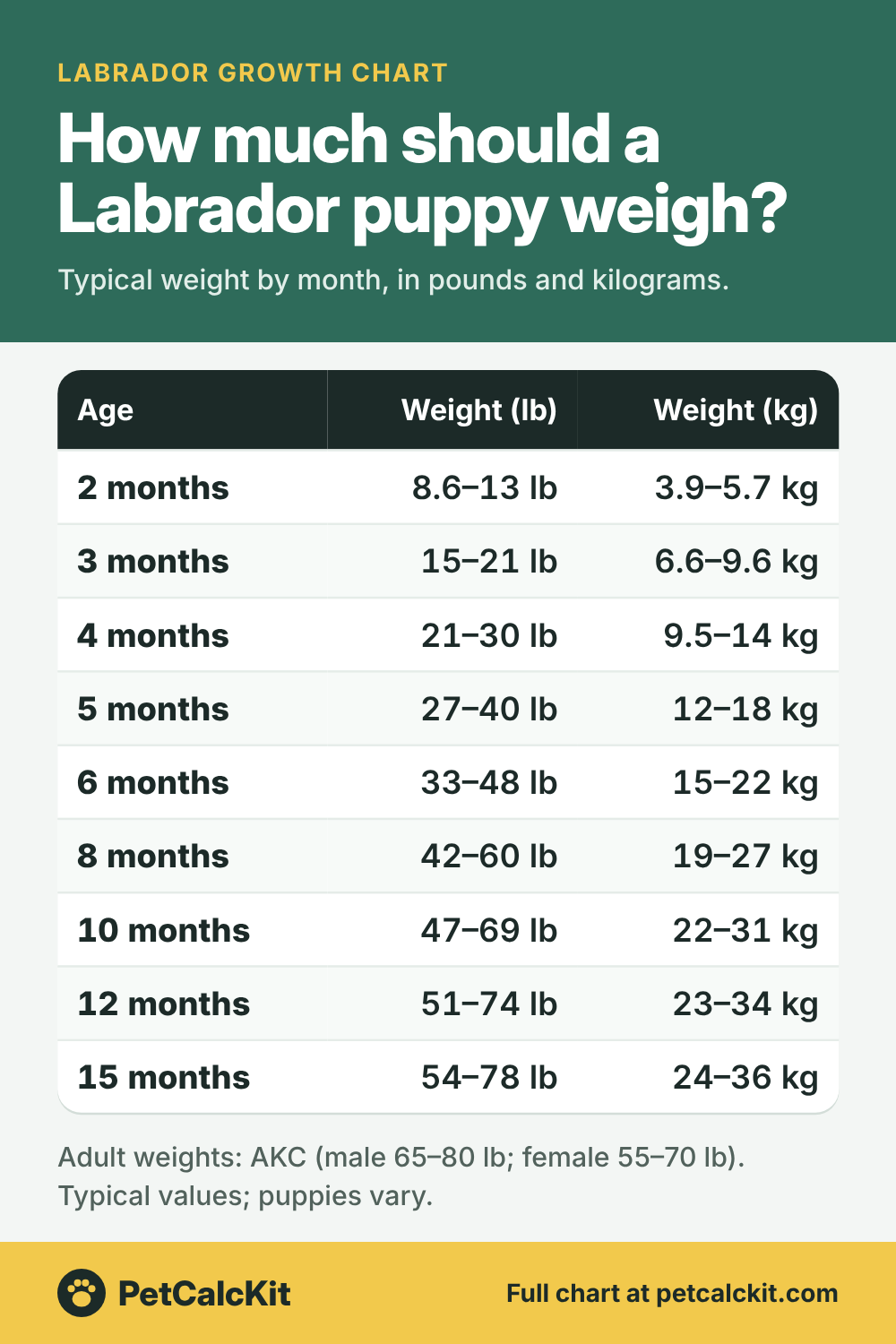
How much should a Labrador puppy weigh? Find the row that matches your puppy's sex and expected adult weight, and read across by age.
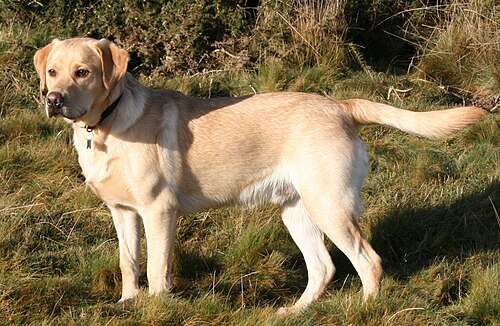

Short answer
Adult Labrador weight, according to the AKC: males 65–80 lb, females 55–70 lb. Most Labradors are close to their adult weight at around 15 months, though many keep filling out with muscle for a while after that.
Labrador puppy weight chart (lb)
| Adult weight | 2 mo | 3 mo | 4 mo | 5 mo | 6 mo | 8 mo | 10 mo | 12 mo | 15 mo |
|---|---|---|---|---|---|---|---|---|---|
| Male, 65 lb | 10 | 17 | 25 | 32 | 39 | 49 | 56 | 60 | 64 |
| Male, 80 lb | 13 | 21 | 30 | 40 | 48 | 60 | 69 | 74 | 78 |
| Female, 55 lb | 8.6 | 15 | 21 | 27 | 33 | 42 | 47 | 51 | 54 |
| Female, 70 lb | 11 | 19 | 27 | 35 | 42 | 53 | 60 | 65 | 69 |
Labrador puppy weight chart (kg)
| Adult weight | 2 mo | 3 mo | 4 mo | 5 mo | 6 mo | 8 mo | 10 mo | 12 mo | 15 mo |
|---|---|---|---|---|---|---|---|---|---|
| Male, 29 kg | 4.6 | 7.8 | 11 | 15 | 18 | 22 | 25 | 27 | 29 |
| Male, 36 kg | 5.7 | 9.6 | 14 | 18 | 22 | 27 | 31 | 34 | 36 |
| Female, 25 kg | 3.9 | 6.6 | 9.5 | 12 | 15 | 19 | 22 | 23 | 24 |
| Female, 32 kg | 5.0 | 8.4 | 12 | 16 | 19 | 24 | 27 | 30 | 31 |
Typical weights by month. Individual puppies often sit 10–15% above or below these numbers. Last reviewed October 7, 2026.
How big does a Labrador get?
According to the American Kennel Club's breed profile for the Labrador Retriever, adults weigh: male 65–80 lb; female 55–70 lb. Life expectancy is 11–13 years.
| Weight | Height | |
|---|---|---|
| Male | 65–80 lb | 22.5–24.5 in |
| Female | 55–70 lb | 21.5–23.5 in |
See how the Labrador compares with other breeds in the dog breed size chart.
When does a Labrador stop growing?
Labradors grow like other large-sized dogs: they are close to adult weight at around 15 months. At 6 months a typical Labrador puppy has reached about 60% of its adult weight.
To estimate your own puppy's adult weight from its current weight and age, use the puppy weight calculator and choose "Large" as the expected adult size.
Raising a Labrador puppy: what to watch
Keep your Lab lean. University of Cambridge researchers found that around one in four Labradors carries at least one copy of a POMC gene variant, and that each copy was linked to dogs being on average 1.9 kg heavier (2016). A 2024 follow-up found carriers burn about 25% fewer calories at rest and are hungrier between meals; one of the researchers said it is very difficult to keep these dogs slim, but it can be done. Measure meals and count treats; the researchers also suggest spreading out each day's food, for example with puzzle feeders.
Puppy food. VCA explains that overfed large-breed puppies grow faster and their skeleton may not keep pace, and advises against mineral and vitamin supplements unless your vet recommends them. PetMD suggests a large-breed puppy food until 1 year, while VCA suggests large-breed growth formulas until about 18 months; ask your vet which fits your puppy.
Exercise-induced collapse (EIC). This inherited condition usually shows between about 5 months and 3 years of age. It is typically triggered by 5–20 minutes of intense exercise with high excitement; dogs are usually normal again within 5 to 25 minutes, though a few have died (University of Minnesota). An EIC DNA test is one of the Labrador Retriever Club's required health tests, along with hips, elbows, an eye exam and a test for the dilute coat gene.
Spay or neuter timing. In a 2020 study (Hart and colleagues, Frontiers in Veterinary Science), joint disorders affected about 6% of intact Labradors, compared with 13% of males neutered before 6 months and 11–12% of females spayed before a year. The authors suggest neutering males after 6 months and delaying spaying females until beyond a year of age. Talk to your vet.
How the chart is made
The adult weights come from the AKC breed profile. The weight at each month is estimated with our large-breed growth curve, which gives the share of adult weight a typical puppy of that size reaches at each age. The curves are simplified from published research on dog growth, including the growth standard charts by Salt and colleagues (PLOS ONE, 2017).
If your puppy is well below or above the chart, stops gaining weight, or looks very thin or round, ask your vet to check its body condition.
Questions people ask
How much should a 3-month-old Labrador weigh?
Typically about 15–21 lb, depending on sex and how big the dog will be as an adult.
How much should a 6-month-old Labrador weigh?
Typically about 33–48 lb, roughly 60% of adult weight.
When do Labradors stop growing?
Most Labradors are close to their adult weight at around 15 months, though many keep filling out with muscle for a while after that.
How much does a full-grown Labrador weigh?
The AKC lists adult weights of male 65–80 lb; female 55–70 lb. Your puppy's parents are a good guide to where in that range it will end up.
Why is my Labrador always hungry?
Many Labs carry a gene variant linked to hunger and weight gain: University of Cambridge research found around one in four Labradors carries at least one copy, and carriers are hungrier between meals and burn fewer calories at rest.
What is exercise-induced collapse in Labradors?
An inherited condition in which a dog collapses after 5–20 minutes of intense, exciting exercise and is usually normal again within 5 to 25 minutes (University of Minnesota). Ask whether the parents were DNA tested.
Sources
- The american kennel club's breed profile for the labrador retriever
- University of Cambridge: Genetic variant may help explain why Labradors are prone to obesity (2016)
- University of Cambridge: Genetic mutation in a quarter of all Labradors hard-wires them for obesity (2024)
- VCA: Nutritional considerations for large and giant breed dogs
- PetMD: Labrador Retriever (veterinarian-reviewed)
- University of Minnesota Canine Genetics: Exercise-induced collapse
- Labrador Retriever Club: Health issues
- Labrador Retriever Club: health statement (AKC)
- Hart et al. 2020, Assisting decision-making on age of neutering for 35 breeds of dogs (Frontiers in Veterinary Science)