Home / Puppy growth chart / Dalmatian
Dalmatian growth chart
How much should a Dalmatian puppy weigh? Find the row that matches your puppy's sex and expected adult weight, and read across by age.


Short answer
Adult Dalmatian weight, according to the AKC: 45–70 lb. Most Dalmatians are close to their adult weight at around 15 months, though many keep filling out with muscle for a while after that.
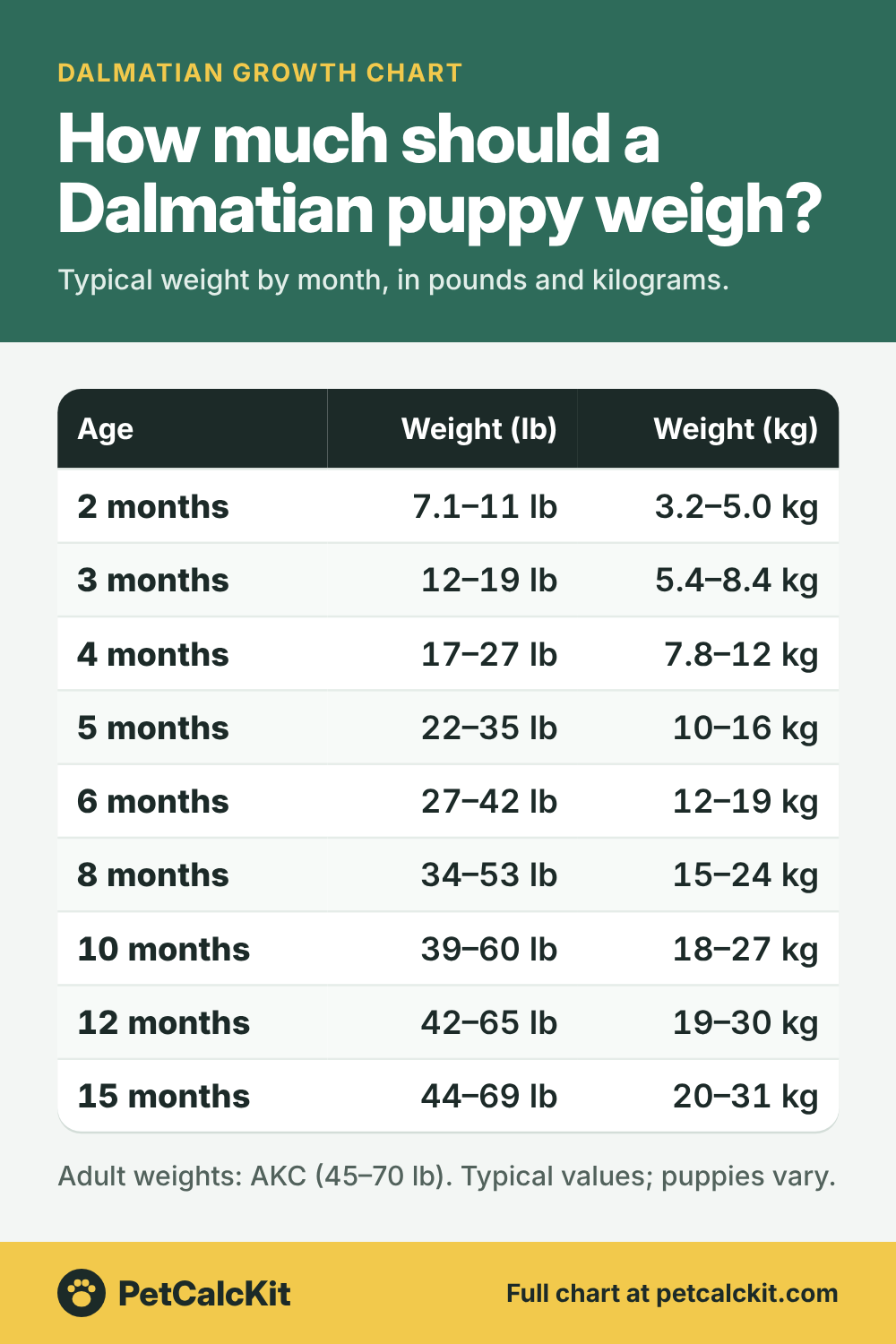
Dalmatian puppy weight chart (lb)
| Adult weight | 2 mo | 3 mo | 4 mo | 5 mo | 6 mo | 8 mo | 10 mo | 12 mo | 15 mo |
|---|---|---|---|---|---|---|---|---|---|
| Male & female, 45 lb | 7.1 | 12 | 17 | 22 | 27 | 34 | 39 | 42 | 44 |
| Male & female, 70 lb | 11 | 19 | 27 | 35 | 42 | 53 | 60 | 65 | 69 |
Dalmatian puppy weight chart (kg)
| Adult weight | 2 mo | 3 mo | 4 mo | 5 mo | 6 mo | 8 mo | 10 mo | 12 mo | 15 mo |
|---|---|---|---|---|---|---|---|---|---|
| Male & female, 20 kg | 3.2 | 5.4 | 7.8 | 10 | 12 | 15 | 18 | 19 | 20 |
| Male & female, 32 kg | 5.0 | 8.4 | 12 | 16 | 19 | 24 | 27 | 30 | 31 |
Typical weights by month. Individual puppies often sit 10–15% above or below these numbers. Last reviewed October 7, 2026.
How big does a Dalmatian get?
According to the American Kennel Club's breed profile for the Dalmatian, adults weigh: male & female 45–70 lb. Life expectancy is 11–13 years.
| Weight | Height | |
|---|---|---|
| Male & female | 45–70 lb | 19–24 in |
See how the Dalmatian compares with other breeds in the dog breed size chart.
When does a Dalmatian stop growing?
Dalmatians grow like other large-sized dogs: they are close to adult weight at around 15 months. At 6 months a typical Dalmatian puppy has reached about 60% of its adult weight.
To estimate your own puppy's adult weight from its current weight and age, use the puppy weight calculator and choose "Large" as the expected adult size.
Raising a Dalmatian puppy: what to watch
Hearing test. The Dalmatian Club of America reports that about 70% of Dalmatians hear in both ears, about 22% hear with only one ear and about 8% don't hear at all, in line with figures from Louisiana State University's deafness research. Hearing is checked with a BAER test, which the club says can be done as early as 5 weeks of age. Ask for your puppy's BAER result.
Urinary stones. Dalmatians carry a gene variant (SLC2A9) that leads to high uric acid in the urine; Nearly all Dalmatians carry the mutation (Cornell, UC Davis), though not all go on to form stones. A blockage from stones is more common in males. Watch for straining, frequent small amounts of urine, accidents or blood in the urine (Cornell). The Merck Veterinary Manual's measures against urate stones include more water in the diet and a low-purine diet; ask your vet before changing food.
Low uric acid (LUA) Dalmatians. A backcross project begun in 1973 with one Dalmatian × Pointer litter produced low uric acid Dalmatians, and in 2011 the AKC voted to accept their descendants.
Health tests to ask a breeder about. The AKC's health-testing list for the breed is a hip evaluation and BAER hearing testing.
How the chart is made
The adult weights come from the AKC breed profile. The weight at each month is estimated with our large-breed growth curve, which gives the share of adult weight a typical puppy of that size reaches at each age. The curves are simplified from published research on dog growth, including the growth standard charts by Salt and colleagues (PLOS ONE, 2017).
If your puppy is well below or above the chart, stops gaining weight, or looks very thin or round, ask your vet to check its body condition.
Questions people ask
How much should a 3-month-old Dalmatian weigh?
Typically about 12–19 lb, depending on sex and how big the dog will be as an adult.
How much should a 6-month-old Dalmatian weigh?
Typically about 27–42 lb, roughly 60% of adult weight.
When do Dalmatians stop growing?
Most Dalmatians are close to their adult weight at around 15 months, though many keep filling out with muscle for a while after that.
How much does a full-grown Dalmatian weigh?
The AKC lists adult weights of male & female 45–70 lb. Your puppy's parents are a good guide to where in that range it will end up.
Are all Dalmatians deaf?
No. The Dalmatian Club of America reports that about 8% are deaf in both ears and about 22% in one ear; the rest hear normally. Ask for your puppy's BAER hearing test result.
Why do Dalmatians get bladder stones?
Dalmatians carry a gene variant that leads to high uric acid in the urine, which can form urate stones (UC Davis, Cornell). A low-purine diet helps prevent new urate stones, and more water in the diet is part of Merck's advice for treating them; ask your vet.
Sources
- The american kennel club's breed profile for the dalmatian
- Dalmatian Club of America: Hearing
- Louisiana State University: Deafness in Dalmatians
- AKC: Non-Sporting Group health testing requirements
- UC Davis Veterinary Genetics Laboratory: Hyperuricosuria
- UC Davis: Dalmatian bladder stones caused by gene that regulates uric acid in humans
- Cornell Riney Canine Health Center: Hyperuricosuria and urolithiasis
- Merck Veterinary Manual: Urolithiasis in dogs
- Powell D: The Dalmatian/Pointer backcross project (2011)