Home / Puppy growth chart / Boston Terrier
Boston Terrier growth chart
How much should a Boston Terrier puppy weigh? Find the row that matches your puppy's sex and expected adult weight, and read across by age.
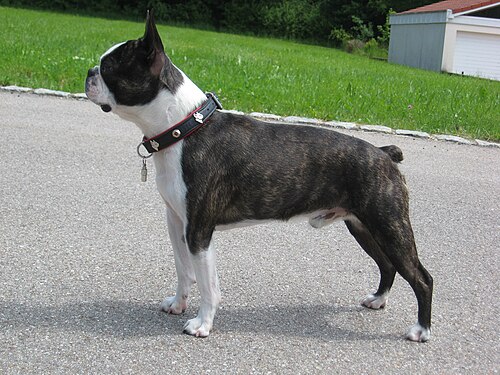

Short answer
Adult Boston Terrier weight, according to the AKC: 12–25 lb. Most Boston Terriers are close to their adult weight at around 11 months, though many keep filling out with muscle for a while after that.
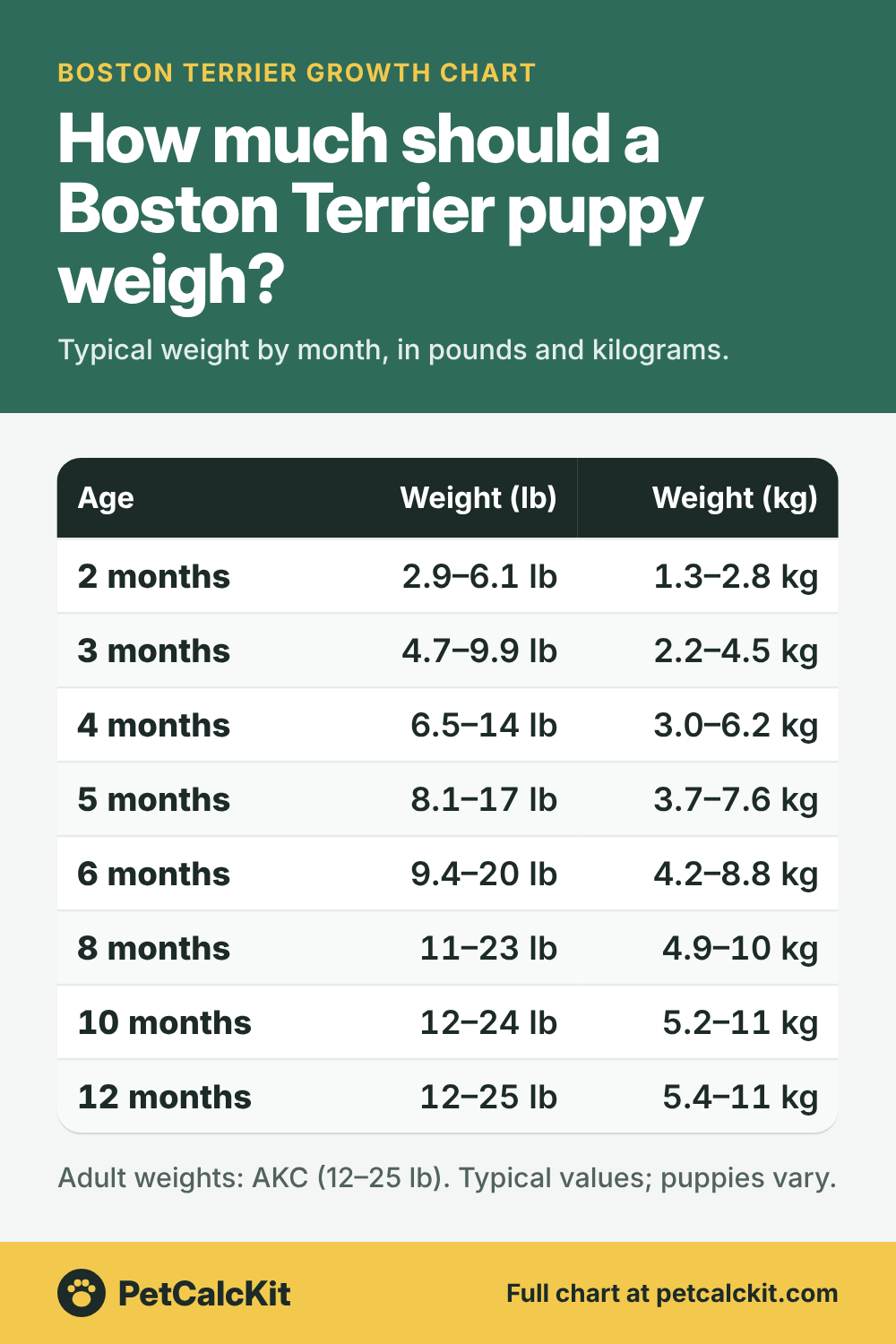
Boston Terrier puppy weight chart (lb)
| Adult weight | 2 mo | 3 mo | 4 mo | 5 mo | 6 mo | 8 mo | 10 mo | 12 mo |
|---|---|---|---|---|---|---|---|---|
| Adult, 12 lb | 2.9 | 4.7 | 6.5 | 8.1 | 9.4 | 11 | 12 | 12 |
| Adult, 25 lb | 6.1 | 9.9 | 14 | 17 | 20 | 23 | 24 | 25 |
Boston Terrier puppy weight chart (kg)
| Adult weight | 2 mo | 3 mo | 4 mo | 5 mo | 6 mo | 8 mo | 10 mo | 12 mo |
|---|---|---|---|---|---|---|---|---|
| Adult, 5.4 kg | 1.3 | 2.2 | 3.0 | 3.7 | 4.2 | 4.9 | 5.2 | 5.4 |
| Adult, 11 kg | 2.8 | 4.5 | 6.2 | 7.6 | 8.8 | 10 | 11 | 11 |
Typical weights by month. Individual puppies often sit 10–15% above or below these numbers. Last reviewed October 7, 2026.
How big does a Boston Terrier get?
According to the American Kennel Club's breed profile for the Boston Terrier, adults weigh: male & female 12–25 lb. Life expectancy is 11–13 years.
| Weight | Height | |
|---|---|---|
| Male & female | 12–25 lb | 10–12 in |
Compare the Boston Terrier with other small dog breeds.
When does a Boston Terrier stop growing?
Boston Terriers grow like other small-sized dogs: they are close to adult weight at around 11 months. At 6 months a typical Boston Terrier puppy has reached about 78% of its adult weight.
To estimate your own puppy's adult weight from its current weight and age, use the puppy weight calculator and choose "Small" as the expected adult size.
Raising a Boston Terrier puppy: what to watch
Three weight classes. Boston Terriers are shown in three weight classes: under 15 pounds, 15 to 20 pounds and 20 to 25 pounds (AKC). The parents' sizes give a rough idea of where your puppy will end up.
Eyes. VCA says corneal ulcers are more common in breeds with short muzzles and prominent eyes, such as Boston Terriers; tearing, squinting and rubbing at the eye are signs that need a vet. PetMD also notes their prominent eyes make injuries more likely. Juvenile hereditary cataracts, which start before 1 year of age and can lead to blindness, also occur in the breed (UC Davis).
Breathing and heat. The American College of Veterinary Surgeons names the Boston Terrier among breeds with brachycephalic syndrome. PetMD says Bostons don't do well in heat and suggests exercising in the mornings and evenings during summer.
Health tests to ask a breeder about. The breed club's recommended tests are kneecaps, an eye exam and a BAER hearing test (AKC).
How the chart is made
The adult weights come from the AKC breed profile. The weight at each month is estimated with our small-breed growth curve, which gives the share of adult weight a typical puppy of that size reaches at each age. The curves are simplified from published research on dog growth, including the growth standard charts by Salt and colleagues (PLOS ONE, 2017).
If your puppy is well below or above the chart, stops gaining weight, or looks very thin or round, ask your vet to check its body condition.
Questions people ask
How much should a 3-month-old Boston Terrier weigh?
Typically about 4.7–9.9 lb, depending on sex and how big the dog will be as an adult.
How much should a 6-month-old Boston Terrier weigh?
Typically about 9.4–20 lb, roughly 78% of adult weight.
When do Boston Terriers stop growing?
Most Boston Terriers are close to their adult weight at around 11 months, though many keep filling out with muscle for a while after that.
How much does a full-grown Boston Terrier weigh?
The AKC lists adult weights of male & female 12–25 lb. Your puppy's parents are a good guide to where in that range it will end up.
How big do Boston Terriers get?
They are shown in three weight classes: under 15 lb, 15–20 lb and 20–25 lb (AKC).
Why is my Boston Terrier squinting?
Squinting, tearing and rubbing at an eye can be signs of a corneal ulcer, which is more common in short-muzzled breeds with prominent eyes like the Boston Terrier (VCA). See your vet promptly.
Sources
- The american kennel club's breed profile for the boston terrier
- AKC: 5 facts about the Boston Terrier
- AKC: Non-Sporting Group health testing requirements
- UC Davis Veterinary Genetics Laboratory: Juvenile hereditary cataract
- American College of Veterinary Surgeons: Brachycephalic syndrome
- VCA: Corneal ulcers in dogs
- PetMD: Boston Terrier (veterinarian-reviewed)