Home / Cat calculators
Kitten feeding chart
Kittens need far more calories per pound than adult cats, split into several small meals a day. Enter your kitten's weight and age to see how much to feed, from bottle feeding a newborn to switching to adult food.
Daily calories, meals and portions will show here.
A starting point, not a prescription. Kittens vary, so weigh yours regularly and ask your vet if it stops gaining or gets chubby. Last reviewed October 9, 2026.
Kitten feeding chart by age
| Age | What to feed | How often |
|---|---|---|
| Birth to 1 week | Mother's milk, or kitten milk replacer by bottle | Every 2–4 hours, day and night |
| 1–3 weeks | Mother's milk or kitten milk replacer only | Every 4–6 hours |
| 3–5 weeks | Weaning starts: kitten food mixed with milk replacer into a gruel | Several small meals, plus milk replacer |
| 5–8 weeks | Kitten food; fully weaned by about 8 weeks | Several small meals |
| 2–6 months | Kitten food | 3–4 meals a day |
| 6–12 months | Kitten food | 2 meals a day |
| About 12 months | Switch to adult food (up to 18 months for Maine Coons and other large breeds) | 2 meals a day |
Bottle-feeding intervals and the switch to adult food are from VCA Animal Hospitals; weaning ages from AAHA, VCA and Alley Cat Allies; meals a day from VCA and the Cornell Feline Health Center. The Merck Veterinary Manual gives a slightly earlier switch, between 8 and 12 months.
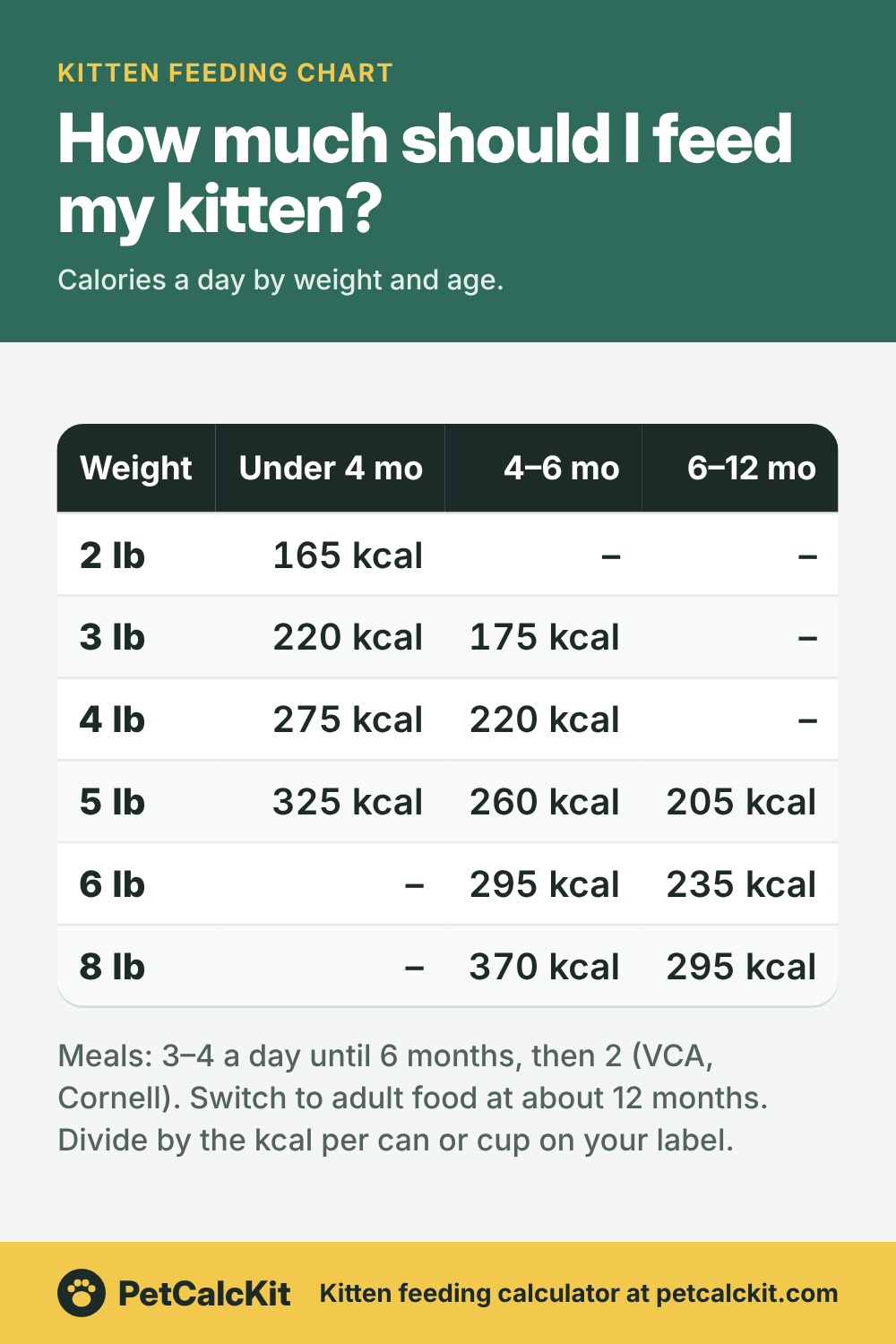
How much to feed a kitten: calories by weight
| Weight | Under 4 mo, kcal | 4–6 mo, kcal | 6–12 mo, kcal |
|---|---|---|---|
| 1 lb (0.45 kg) | 95 | – | – |
| 2 lb (0.9 kg) | 165 | – | – |
| 3 lb (1.4 kg) | 220 | 175 | – |
| 4 lb (1.8 kg) | 275 | 220 | – |
| 5 lb (2.3 kg) | 325 | 260 | 205 |
| 6 lb (2.7 kg) | – | 295 | 235 |
| 8 lb (3.6 kg) | – | 370 | 295 |
| 10 lb (4.5 kg) | – | – | 350 |
| 12 lb (5.4 kg) | – | – | 400 |
Calories a day, rounded. Dashes mark weights that are unusual at that age. To turn calories into food, divide by the kcal per can or cup on your label: a 3 lb kitten under 4 months needs about 220 kcal, so with a food of 80 kcal per can that is about 2¾ cans a day.
The numbers start from the resting energy requirement (RER = 70 × body weight in kg0.75). The Merck Veterinary Manual uses 2.5 × RER for growing kittens, and the Pet Nutrition Alliance gives 2–3 × RER, noting that needs start to fall at about 4 months as growth slows. We use 2.5 × RER under 4 months, 2 × RER from 4 to 6 months, and 1.6 × RER from 6 months, which matches the 80 kcal per kg that AAHA gives for a typical kitten at 10 months. At 10 weeks AAHA gives 200 kcal per kg, a little more than 2.5 × RER for a kitten that age, so very young kittens may need a bit more than the table shows.
How often to feed a kitten
Kittens have small stomachs, so they need their food in several meals. VCA says most kittens do best with their daily portion split into 3–4 small meals or more, and Cornell recommends three meals a day until 6 months and two meals a day from 6 months to a year.
Sources disagree on free feeding. Merck says kittens can be fed free choice or several times a day, while VCA says portion feeding gives the best chance of keeping a kitten from getting overweight. If you leave dry food out, measure the day's amount in the morning rather than topping up the bowl.
Bottle feeding newborn kittens
Kittens without a mother need a commercial kitten milk replacer. VCA says milk replacers are better than cow's milk or homemade mixtures, and they are the only food until 3–4 weeks of age.
- How much: VCA gives 15 kcal per 100 g of body weight a day for days 1–3, 20 kcal for days 4–6, and up to 25 kcal after that. Divide by the kcal per mL on your formula to get mL a day.
- Per feeding: a kitten's stomach holds about 4 mL per 100 g of body weight (Maddie's Fund), so a 100 g newborn takes only about 4 mL at a time.
- How often: every 2–4 hours in the first week, then every 4–6 hours until weaning (VCA).
- How: warm the formula to about 100°F (38°C) and feed the kitten on its belly with its head level, never on its back like a human baby.
- Too much: VCA says it is better to slightly underfeed than to overfeed. If the kitten gets diarrhea, reduce the amount and call your vet.
Weigh bottle-fed kittens every day in grams. VCA says they should gain at least 7 g a day, and the ASPCA says normal kittens gain 7–15 g a day. The kitten growth chart shows normal weights week by week.
Weaning a kitten
Weaning starts at about 3–5 weeks. Mix a little wet kitten food with milk replacer into a thin gruel, offer it in a shallow dish, and make it thicker over the next weeks. Alley Cat Allies says kittens are almost fully weaned by about 7 weeks and fully weaned by about 8 weeks.
When to switch to adult cat food
VCA recommends switching at 1 year of age or when the kitten has reached maturity, whichever comes later. Large breeds such as Maine Coons may need kitten food for up to 18 months. Merck says kittens usually move to an adult diet between 8 and 12 months. Change foods gradually over 7–14 days.
The label is only a starting point. Choose a food labeled complete and balanced for growth or for all life stages, check your kitten's body condition as it grows, and keep treats under 10% of daily calories.
Questions people ask
How much should a kitten eat a day?
About 2.5 times its resting energy requirement until 4 months, then less as growth slows. A 2 lb kitten under 4 months needs about 165 kcal a day and a 3 lb kitten about 220 kcal. Divide by the kcal per can or cup on your food to get the amount.
How much wet food should I feed my kitten?
It depends on the calories in the can, which vary a lot. Find the kcal per can on the label and divide your kitten's daily calories by it. For example, a 3 lb kitten under 4 months needs about 220 kcal, or about 2¾ cans a day of a food with 80 kcal per can.
How often should a kitten eat?
Newborns every 2–4 hours, then every 4–6 hours until weaning. After weaning, 3–4 small meals a day until 6 months, then 2 meals a day.
When should a kitten switch to adult food?
At about 1 year, or when it reaches maturity if that is later. Maine Coons and other large breeds may stay on kitten food until 18 months.
Can kittens drink cow's milk?
Use a kitten milk replacer instead. VCA says milk replacers are better than cow's milk and homemade mixtures.
How much formula does a newborn kitten need?
About 15–25 kcal per 100 g of body weight a day depending on age, and no more than about 4 mL per 100 g of body weight at a single feeding. Weigh the kitten every day to check it is gaining.
Sources
- Merck Veterinary Manual: Daily maintenance energy requirements for dogs and cats
- Merck Veterinary Manual: Feeding practices in small animals
- Pet Nutrition Alliance: Calculating calories based on pet needs
- AAHA/AAFP: 2021 Feline Life Stage Guidelines, nutrition for kittens
- VCA Animal Hospitals: Feeding growing kittens
- VCA Animal Hospitals: Feeding orphaned kittens
- VCA Animal Hospitals: When to switch a kitten to adult food
- Cornell Feline Health Center: How often should you feed your cat?
- Maddie's Fund: Kitten bottle feeding and stomach capacity chart
- ASPCA: Kitten bottle feeding guide
- ASPCA: Kitten progression chart
- Alley Cat Allies: Kitten progression