Home / Dog calculators
Dog xylitol toxicity calculator
Xylitol, a sweetener in sugar-free gum, mints and some peanut butters, is one of the most dangerous foods for dogs. Enter your dog's weight and how much it ate to compare with the doses that cause poisoning.
Short answer
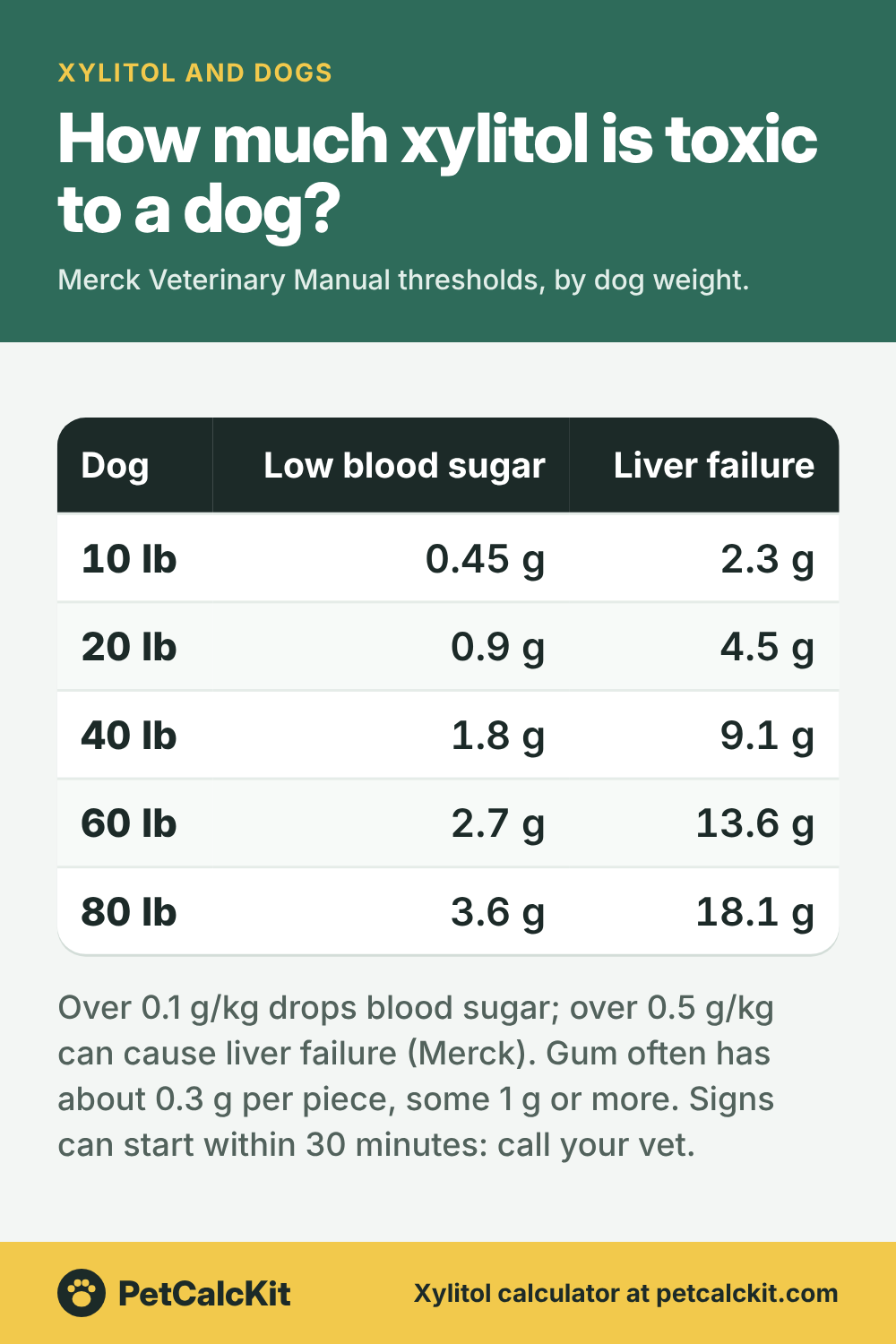
The Merck Veterinary Manual says more than about 0.1 g of xylitol per kg of body weight can cause dangerously low blood sugar in dogs, and more than about 0.5 g/kg can cause liver failure. Sugar-free gum often has about 0.3 g per piece, so as little as 1–2 pieces can be dangerous for a 10 lb dog. Signs can start within 30 minutes: if your dog ate anything with xylitol, call your vet now.
The result and what to do next will show here.
A guide for deciding how urgently to call, not a diagnosis. With xylitol, always call your vet. Last reviewed October 22, 2026.
How much xylitol is toxic to dogs?
The Merck Veterinary Manual gives two thresholds: more than about 100 mg (0.1 g) of xylitol per kg of body weight can cause hypoglycemia, and more than about 500 mg (0.5 g) per kg can cause severe liver damage. Some poison centers, such as Tox Info Suisse, already advise treatment from 0.05 g per kg.
| Dog's weight | Low blood sugar risk | Liver failure risk |
|---|---|---|
| 5 lb (2.3 kg) | 0.23 g (about 1 piece of gum) | 1.1 g (about 4 pieces) |
| 10 lb (4.5 kg) | 0.45 g (about 1½ pieces) | 2.3 g (about 8 pieces) |
| 20 lb (9.1 kg) | 0.9 g (about 3 pieces) | 4.5 g (about 15 pieces) |
| 40 lb (18.1 kg) | 1.8 g (about 6 pieces) | 9.1 g (about 30 pieces) |
| 60 lb (27.2 kg) | 2.7 g (about 9 pieces) | 13.6 g (about 45 pieces) |
| 80 lb (36.3 kg) | 3.6 g (about 12 pieces) | 18.1 g (about 60 pieces) |
Gum pieces are counted at 0.3 g of xylitol each, the estimate suggested by an ASPCA toxicologist (Dunayer, 2006). Brands vary: the AKC puts gum and mints at about 0.22–1.0 g per piece, and Tox Info Suisse says a piece can contain up to 1.8 g, so with a high-xylitol gum far fewer pieces can be enough. A car cup of gum typically holds 40 to 50 pieces (ASPCA).
Which products contain xylitol?
The FDA lists sugar-free gum, breath mints, baked goods, cough syrup, chewable vitamins, mouthwash, toothpaste, some nut butters, over-the-counter medicines, dietary supplements and some "skinny" ice creams. On labels, xylitol may also be called birch sugar or wood sugar. Check peanut butter before using it for treats or pills.
Signs of xylitol poisoning and when they start
- Low blood sugar: vomiting, weakness, wobbliness, lethargy, collapse, seizures and coma (Merck, FDA). The FDA says this can start within 10 to 60 minutes.
- Delayed signs: with some gums, low blood sugar may be delayed up to 12–18 hours (Merck), so a dog that seems fine at first still needs a vet.
- Liver damage: vomiting, yellow gums or eyes (jaundice) and bleeding problems may not appear until 24–48 hours or more after eating xylitol (Merck).
What to do if your dog ate xylitol
- Keep the package and work out how much was eaten and when.
- Call your vet, an emergency vet or a pet poison line right away, even if your dog seems well.
- Don't make your dog vomit unless a vet tells you to. The Pet Poison Helpline says a vet may induce vomiting if the xylitol was eaten within the past six hours and the dog has no signs yet.
- Expect blood sugar checks and possibly a hospital stay: Merck recommends checking glucose every 1–2 hours for at least 12 hours. Activated charcoal does not bind xylitol well and is not recommended.
The outlook is good for low blood sugar that is caught and treated early, according to the Merck Veterinary Manual. It is much worse once the liver is affected: in one study Merck cites, more than 6 in 10 dogs with signs of liver injury died or were euthanized.
Questions people ask
How much xylitol is toxic to dogs?
More than about 0.1 g per kg of body weight (0.045 g per lb) can cause dangerously low blood sugar, and more than about 0.5 g per kg can cause liver failure, according to the Merck Veterinary Manual. For a 20 lb dog that is about 0.9 g and 4.5 g.
How many pieces of gum can kill a dog?
There is no exact number, because gums contain different amounts of xylitol. At about 0.3 g per piece, 1–2 pieces can cause low blood sugar in a 10 lb dog, and about 8 pieces reach the dose linked to liver failure. Gums with up to 1 g per piece are far more dangerous. Both conditions can be fatal without treatment, so call your vet after any amount.
My dog ate gum. What should I do?
Check the ingredients for xylitol (or birch sugar). If it has xylitol or you aren't sure, call your vet or a pet poison line now, before signs appear.
How long after eating xylitol will a dog show symptoms?
Signs can start within 10 to 60 minutes (FDA), sometimes in as little as 10–15 minutes (Pet Poison Helpline), but with some gums they can be delayed up to 12–18 hours (Merck). Signs of liver damage may take 24–48 hours or longer.
Does peanut butter have xylitol?
Some brands do: the FDA lists nut butters among the products that can contain xylitol. Read the label, including for "birch sugar", before giving any to your dog.
Is xylitol toxic to cats?
Much less is known. The Merck Veterinary Manual says dogs are the only domestic species in which xylitol poisoning has been reported, and the FDA says it does not seem to be as dangerous for cats. If your cat ate xylitol, call your vet anyway.
Sources
- Merck Veterinary Manual: Xylitol toxicosis in dogs
- FDA: Paws off xylitol; it's dangerous for dogs
- Pet Poison Helpline: Xylitol toxicosis in dogs
- ASPCA: Updated safety warning on xylitol
- Dunayer EK: New findings on the effects of xylitol ingestion in dogs (dvm360)
- American Kennel Club: Dog accidentally ate gum
- Tox Info Suisse: Xylitol is toxic to dogs